- DIRECT CONTACTS:
- +256 766 009 702
- +256 772 166 444
- info@menlyntours.com

Uganda Safaris: The Ultimate Guide to Exploring the Pearl of Africa

When people begin planning an African safari, the conversation usually starts with Kenya or Tanzania. It’s understandable—those destinations have long been associated with vast plains and the Great Migration. But ask experienced safari travellers where they found the most varied wildlife experience, and Uganda enters the conversation surprisingly often.
The reason is simple. Uganda doesn’t ask you to choose between primates and classic safaris. It gives you both.
Within a single journey, you can spend one morning hiking through an ancient rainforest to find a family of endangered mountain gorillas, another cruising the Kazinga Channel as elephants feed along the shoreline, and the next watching giraffes wander across the open savannah beneath the rising sun. Few countries offer that kind of variety without requiring multiple flights or weeks of travel.
That’s what makes Uganda different.
Often called the Pearl of Africa, Uganda is a country where landscapes change as quickly as the experiences themselves. Tropical rainforests give way to rolling tea plantations, volcanic mountains overlook crater lakes, and open grasslands stretch toward the snow-capped Rwenzori Mountains. Every region feels like a new destination, yet together they create one of Africa’s most rewarding safari circuits.
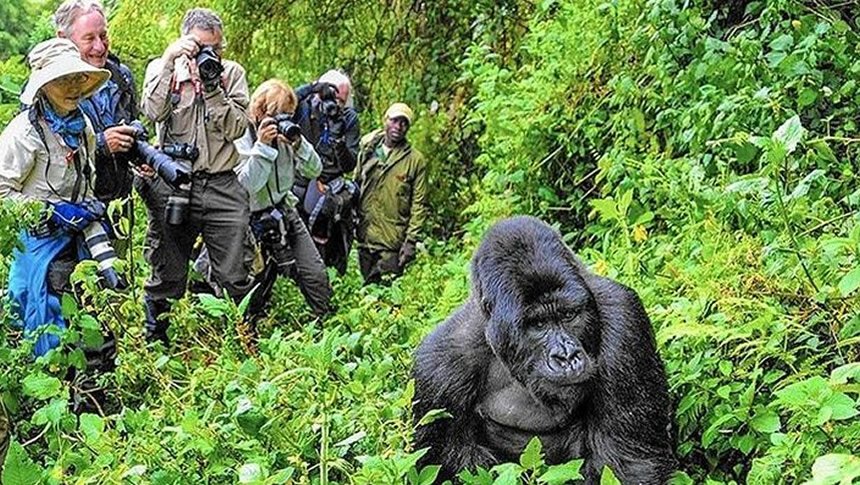
For many visitors, gorilla trekking becomes the headline experience. And rightly so. Spending an hour with a wild mountain gorilla family in Bwindi Impenetrable National Park is one of the world’s most extraordinary wildlife encounters. But reducing Uganda to gorillas alone misses the bigger picture.
The country’s national parks are remarkably diverse. Murchison Falls National Park combines classic game drives with the dramatic power of the Nile squeezing through the world’s most powerful waterfall. Queen Elizabeth National Park is famous for its tree-climbing lions, the wildlife-rich Kazinga Channel, and landscapes that range from open savannah to volcanic crater lakes. Kibale Forest offers some of Africa’s finest chimpanzee tracking, while Kidepo Valley National Park remains one of the continent’s most remote and rewarding wilderness areas.
What surprises many travellers isn’t just the wildlife—it’s how naturally these experiences fit together. Uganda’s southwest allows visitors to combine gorilla trekking, chimpanzee tracking, game drives, and cultural encounters in a single itinerary without spending every day on the road. It’s one of the reasons safari planners often recommend Uganda to travellers looking for more than a traditional wildlife holiday.
Another reason people return is the atmosphere. Uganda still feels authentic. Roads wind through villages where children wave as you pass, roadside markets overflow with fresh produce, and conversations with local communities become just as memorable as the wildlife itself. Safari here isn’t only about ticking animals off a checklist. It’s about understanding the landscapes, the conservation work that protects them, and the people who call these places home.
Whether you’re planning your first safari, celebrating a honeymoon, travelling as a family, or organising a once-in-a-lifetime adventure with friends, Uganda offers itineraries that can be tailored around your interests, travel style, and budget.
This guide brings together everything you need to know before booking a Uganda safari. We’ll look at the country’s best national parks, explain what gorilla trekking is really like, explore when to visit, discuss safari costs, highlight the wildlife you can expect to see, and share practical advice that helps you make the most of your time in the Pearl of Africa.
By the end, you’ll understand why so many travellers arrive expecting one unforgettable experience—and leave talking about ten.
Why Uganda Safaris Stand Apart
Every safari destination has something it does exceptionally well.
Kenya has the Maasai Mara and the Great Migration. Tanzania offers the endless plains of the Serengeti. Botswana is renowned for exclusive wilderness experiences, while South Africa combines excellent wildlife viewing with easy accessibility.
Uganda takes a different approach.
Instead of building an itinerary around one ecosystem, it allows travellers to experience several completely different environments in a single holiday.
A typical Uganda safari might begin with rhino tracking on foot at Ziwa Rhino Sanctuary before continuing north to Murchison Falls National Park for classic game drives and a boat cruise on the Nile. From there, the journey heads west into Kibale Forest to track wild chimpanzees before continuing to Queen Elizabeth National Park in search of elephants, buffaloes, lions, leopards, and the famous tree-climbing lions of Ishasha. The adventure reaches its peak in Bwindi, where mountain gorilla trekking provides one of the most intimate wildlife encounters on Earth, before ending beside the peaceful waters of Lake Bunyonyi.
Rather than repeating the same activity in different locations, each destination adds something completely new to the journey.
That variety is Uganda’s greatest strength.
It also means travellers leave with a richer understanding of East Africa’s landscapes, wildlife, and cultures than they might from a safari focused on a single ecosystem.
For anyone wondering whether Uganda is “worth it,” the better question is this:
Where else can you combine gorilla trekking, chimpanzee tracking, rhino tracking, classic game drives, boat safaris, birdwatching, community experiences, volcanic landscapes, and one of the world’s most powerful waterfalls-all in one carefully planned itinerary?